
What Is a Rule-Based Forex Strategy?
A rule-based forex strategy is a trading system where every decision is governed by predefined, objective rules. There's no room for interpretation, emotion, or second-guessing. You define your entry conditions, exit conditions, position sizing, and risk parameters — then you follow them without deviation.This isn't the same as a fully automated Expert Advisor (EA), although rule-based strategies can be automated later. The point is to create a repeatable, testable process that you can backtest, forward-test, and refine over time.Why Rules Matter More Than Indicators
Beginners obsess over finding the "right" indicator. Professionals obsess over building the right process. Here's the truth: RSI, MACD, moving averages — they all "work" in some market conditions and fail in others. The difference between a winning trader and a losing one isn't which indicator they use. It's whether they have clear rules for when to act and when to sit on their hands.A rule-based approach gives you:- Consistency — you take the same setups every time, avoiding emotional drift
- Backtest validity — if your rules are objective, your backtest results are meaningful
- Accountability — you can review your trades against your rules and identify breakdowns
- Scalability — once proven, you can size up or automate with confidence
Step 1: Define Your Trading Edge
Before you open MT5, you need to answer one question: what market inefficiency are you exploiting?Every profitable rule-based forex strategy has an edge — a structural reason why it makes money. Without one, you're just gambling with extra steps. Common edges in forex include:- Trend continuation — entering pullbacks in established trends (works because trends persist due to institutional order flow)
- Mean reversion — fading overextended moves at key levels (works because price tends to oscillate around fair value in ranging markets)
- Breakout momentum — entering on range expansions after consolidation (works because compressed volatility tends to precede directional moves)
- Session-based patterns — exploiting predictable behaviour around London/New York opens (works because liquidity surges create directional bias)
Step 2: Choose Your Timeframe and Pairs
Your timeframe determines everything — from how many trades you'll take to how much screen time you need. Be honest about your lifestyle and risk tolerance.Timeframe Selection Guidelines
| Timeframe | Style | Avg. Trades/Week | Screen Time |
|---|---|---|---|
| M15–M30 | Intraday | 5–15 | 2–4 hrs/day |
| H1–H4 | Swing (short) | 3–8 | 30–60 min/day |
| D1 | Swing (long) | 1–3 | 15 min/day |
| W1 | Position | 0–1 | Weekly review |
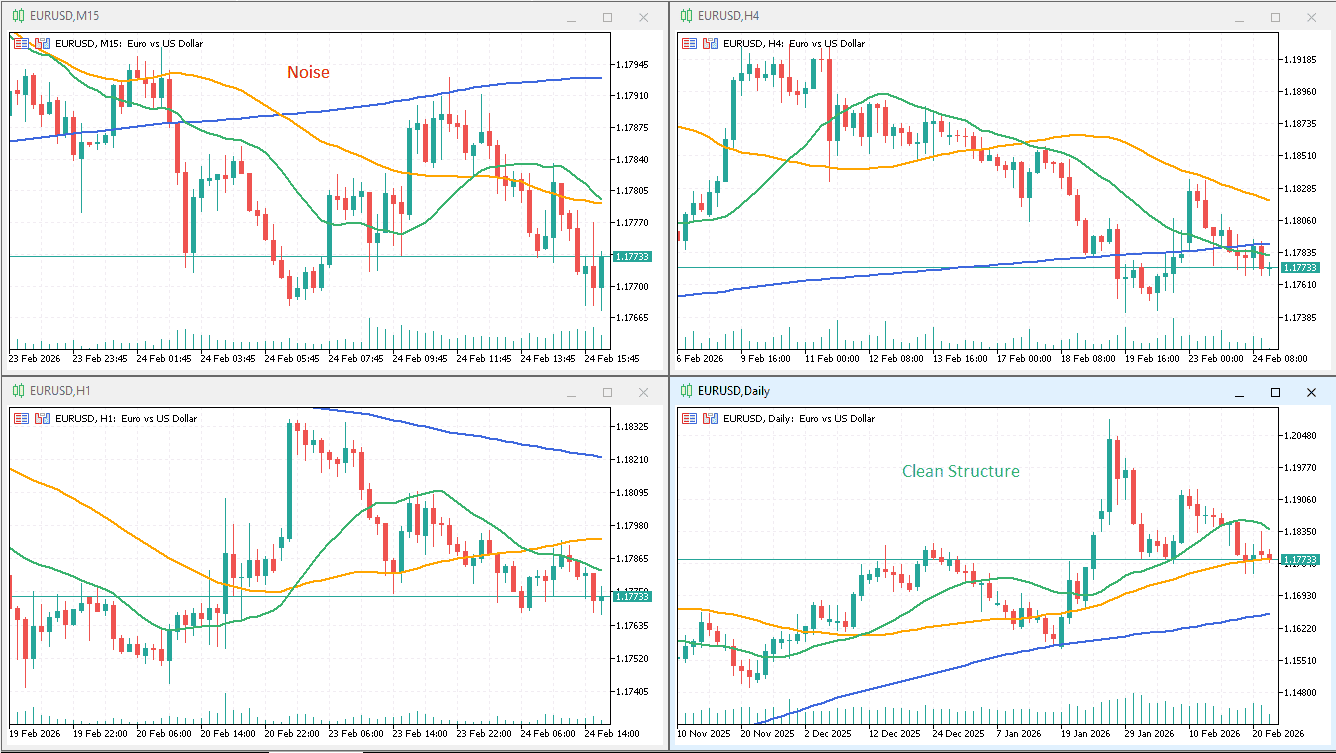
Why higher timeframes produce cleaner, more reliable signals
Pair Selection
Stick to major pairs (EUR/USD, GBP/USD, USD/JPY, AUD/USD) and a handful of liquid crosses. Avoid exotics — wider spreads and erratic price action make rule-based strategies harder to validate. Your strategy should work on at least 2–3 pairs to demonstrate robustness.Step 3: Build Your Entry Rules in MT5
This is where most traders overcomplicate their rule-based forex strategy. Your entry rules should be simple, objective, and pass the "could a stranger execute this?" test. If someone else can't look at your rules and know exactly when to enter, they're not specific enough.Structure Your Entry With Conditions and Filters
Break your entry into two components:- Setup conditions (the environment must be right)
- Trigger (the specific signal that fires the trade)
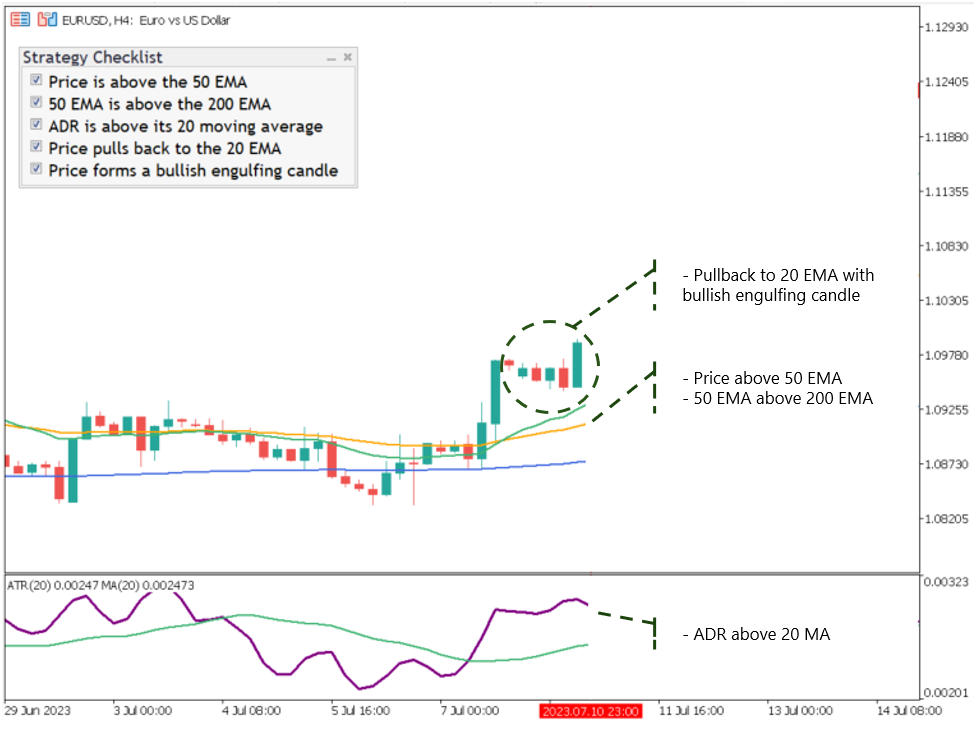
Annotated entry example showing setup, filter, and trigger
- Setup: Price is above the 50 EMA AND the 50 EMA is above the 200 EMA (confirms uptrend)
- Filter: Current ADR (Average Daily Range) is above its 20-period moving average (ensures enough volatility for follow-through; note: ADR values vary by pair — GBP/USD averages ~90 pips, EUR/USD ~70 pips)
- Trigger: Price pulls back to the 20 EMA and forms a bullish engulfing candle (define precisely: current candle's body fully closes above prior candle's high, with body size at least 50% of total candle range)
Implementing in MT5
In MT5, add your indicators to the chart and use templates to save your setup. This ensures consistency across sessions. Here's how:- Open your chart and apply your indicators (e.g., 20 EMA, 50 EMA, 200 EMA)
- Set the colours and line styles so conditions are visually clear
- Right-click the chart → Templates → Save Template
- Name it something specific like
TrendContinuation_H4
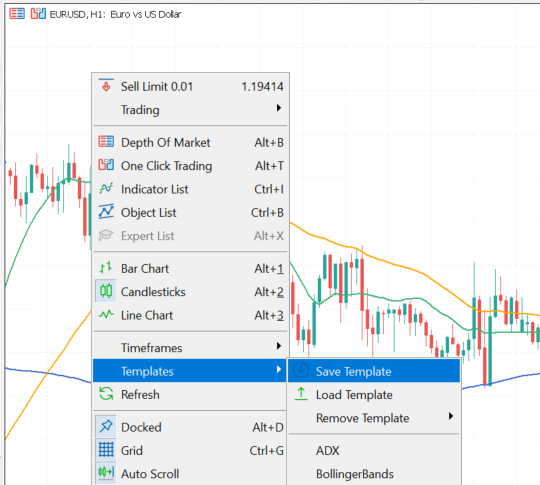
Saving your MT5 template ensures consistent execution
Step 4: Define Exit Rules (Before You Enter)
The exit is where the money is made or lost. You need three exit scenarios defined before you place any trade:1. Stop Loss (Non-Negotiable)
Your stop loss must be based on market structure, not an arbitrary pip count. Good stop placement options:- Below the most recent swing low (for longs)
- Below the entry candle's low + a buffer of 0.5–1× ATR(14) of your entry timeframe (scales with volatility and eliminates broker-dependent arbitrary pip counts)
- Below the relevant moving average by X ATR
2. Take Profit
Define your target using one of these approaches:- Fixed R:R — e.g., always target 2:1 reward-to-risk
- Structure-based — next resistance/support level, Fibonacci extension
- Trailing stop — move stop to breakeven after 1R, trail with a 2x ATR distance
3. Time-Based Exit
Often overlooked, but critical. If a trade hasn't moved in your favour after X candles, close it. Dead trades tie up margin and mental energy. For an H4 chart, a reasonable rule might be: "If not at +1R within 5 candles (20 hours), close at market."Step 5: Position Sizing and Risk Management
This section isn't optional — it's the single biggest factor in long-term survival for any rule-based forex strategy.The 1% Rule
Risk no more than 1% of your account equity per trade. Here's the formula:Lot Size = (Account Equity × Risk %) / (Stop Loss in Pips × Pip Value)MT5 makes this straightforward. Use the built-in Trade panel or a position size calculator script. Several free ones are available on the MQL5 marketplace — just verify they account for the correct pip value for each pair.Correlation Management
If you're trading EUR/USD long and GBP/USD long at the same time, you're essentially doubling your USD short exposure. Rule: Never have more than 2 correlated positions open simultaneously. Use MT5's correlation matrix tools or simply track your net exposure by currency.Step 6: Backtest Your Rule-Based Forex Strategy in MT5
MT5's built-in Strategy Tester is powerful for automated strategies, but even for manual rule-based strategies, you can (and should) backtest in MT5. Here's the process:Manual Backtesting Method
- Open a chart and scroll back at least 2 years of data (use the History Center to download quality data if needed)
- Move through the chart bar-by-bar using F12 (step forward one candle)
- When you see your setup conditions met, evaluate the trigger
- If triggered, record the trade in a spreadsheet: date, pair, direction, entry price, stop, target, result
- Track at least 100 trades before drawing conclusions
Key Metrics to Track
- Win rate — percentage of trades that hit TP
- Average R:R — average reward vs. average risk
- Expectancy — (Win% × Avg Win) – (Loss% × Avg Loss) — must be positive
- Max drawdown — largest peak-to-trough decline in equity
- Profit factor — gross profit ÷ gross loss — aim for above 1.5
- Max consecutive losses — critical for psychology; for a 40% win-rate strategy, expect streaks of 10–15 consecutive losses. Calculate the probability for your specific win rate and ensure your risk rules can absorb it without blowing your account.
Step 7: Forward Test With a Demo Account
Once your backtest shows a positive expectancy over 100+ trades, run your rule-based forex strategy forward on an MT5 demo account for at least 30 trading days. This validates that:- Your rules work in live market conditions (not just on historical charts)
- You can actually execute the trades when signals appear
- Slippage and spread costs don't erode your edge
- You can follow the rules under real-time psychological pressure
Step 8: Document Everything in a Trading Plan
Your trading plan is the final layer. It turns your rule-based forex strategy into a complete operating procedure. It should include:- Strategy name and version number
- Markets and timeframes traded
- Complete entry, exit, and position sizing rules
- Maximum daily/weekly loss limit (e.g., stop trading after 3% daily drawdown)
- Session times you will trade
- Review schedule (weekly trade review, monthly strategy review)
- Conditions under which you will pause or retire the strategy
Your Rule-Based Forex Strategy Checklist
Use this checklist every time you develop or refine a rule-based forex strategy. Don't go live until every box is checked.Strategy Foundation
- ☐ Edge clearly identified and documented
- ☐ Single timeframe selected (with optional higher-timeframe filter)
- ☐ 2–4 currency pairs selected based on liquidity and spread costs
- ☐ Spread-to-stop ratio calculated (must be below 5%)
Entry Rules
- ☐ Setup conditions are 100% objective (no subjective interpretation)
- ☐ Entry trigger is specific and unambiguous
- ☐ A complete stranger could execute your entries from the written rules alone
- ☐ News filter defined (avoid trades around high-impact events)
Exit Rules
- ☐ Stop loss placement based on market structure (not arbitrary pips)
- ☐ Take profit target defined (fixed R:R, structure, or trailing method)
- ☐ Time-based exit rule included
Risk Management
- ☐ Per-trade risk capped at 1% (or less) of equity
- ☐ Position sizing formula documented and tested
- ☐ Correlation rules defined (max exposure per currency)
- ☐ Daily/weekly drawdown limit set
Validation
- ☐ Backtested on 100+ trades over 2+ years of data
- ☐ Out-of-sample validation performed (30% holdout data)
- ☐ Positive expectancy confirmed
- ☐ Profit factor above 1.3 (ideally above 1.5)
- ☐ Max drawdown within your psychological tolerance
- ☐ Max consecutive loss streak probability calculated
Execution
- ☐ Forward-tested on demo for 30+ trading days
- ☐ Demo results show similar expectancy to backtest
- ☐ MT5 chart template saved and tested
- ☐ Alerts configured for setup zones
- ☐ Trading plan written and reviewed