
Bollinger Bands are one of the most widely used volatility indicators in trading — and one of the most misused. When applied correctly in MetaTrader 5 (MT5), they give you a precise read on market volatility, dynamic support and resistance, and high-probability trade setups across any timeframe or instrument.
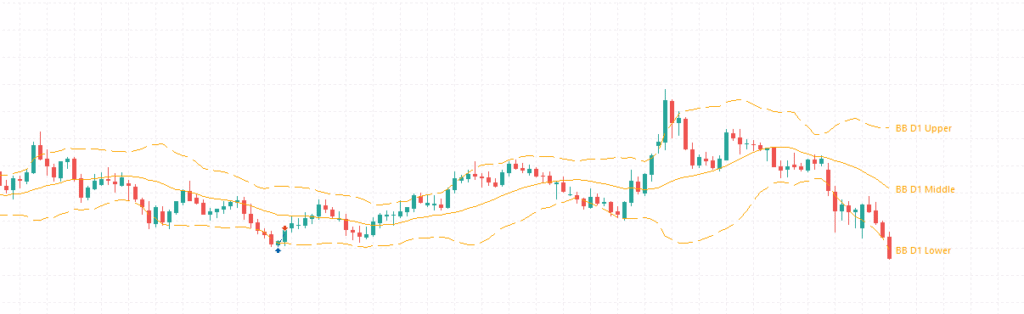
Bollinger Bands indicator on EUR/USD H1 chart in MetaTrader 5 showing squeeze and expansion
In this guide you will learn:
- What Bollinger Bands are and the statistics behind them
- How to set them up correctly in MT5
- Three proven trading strategies with full entry, stop-loss, and take-profit rules
- How to combine Bollinger Bands with RSI and volume for stronger confluence
- Multi-timeframe techniques professional traders use
- The most common mistakes — and how to avoid them
What Are Bollinger Bands?
Bollinger Bands are a volatility indicator developed by technical analyst John Bollinger in the early 1980s and published in his 2001 book Bollinger on Bollinger Bands. They are now considered a standard tool in technical analysis and are included natively in MT5. You can read John Bollinger’s own methodology at BollingerBands.com.
The indicator consists of three lines plotted directly on your price chart:
- Middle Band — a 20-period Simple Moving Average (SMA)
- Upper Band — the SMA plus 2 standard deviations
- Lower Band — the SMA minus 2 standard deviations
The 2 standard deviation setting is not arbitrary. In a normal distribution, approximately 95% of all price data falls within 2 standard deviations of the mean. This is the statistical basis of the indicator: when price moves outside the bands, it is doing something statistically unusual — and the market tends to respond. The concept of standard deviation and its application to financial markets is well documented by Investopedia’s Bollinger Bands reference.
As volatility rises, the bands widen to contain the expanded price range. As volatility contracts, the bands narrow. This dynamic expansion and contraction is what makes Bollinger Bands so useful for identifying:
- Volatility expansion and contraction cycles
- Potential breakout conditions (the Bollinger Squeeze)
- Dynamic support and resistance
- Overbought and oversold conditions in ranging markets
- Trend strength — when price consistently rides a band
Bandwidth and %B: Two Key Extensions
Beyond the three bands themselves, two derived measurements are worth knowing:
- Bandwidth — measures how wide the bands are relative to the middle band. Low bandwidth signals a squeeze (low volatility); high bandwidth signals an expansion. Watching bandwidth historically on your instrument tells you when conditions are truly compressed.
- %B — tells you exactly where price is within the bands, expressed as a value from 0 to 1 (with 1 = upper band, 0 = lower band). A %B above 1.0 means price has broken above the upper band; below 0 means it has broken below the lower band. John Bollinger considers %B one of the most important derived indicators from the system.
How to Add Bollinger Bands in MT5
MT5 includes Bollinger Bands as a built-in indicator. To add them to your chart:
- Open MetaTrader 5 and load your chart
- Click Insert → Indicators → Trend → Bollinger Bands
- Set your parameters (see recommended settings below)
- Click OK
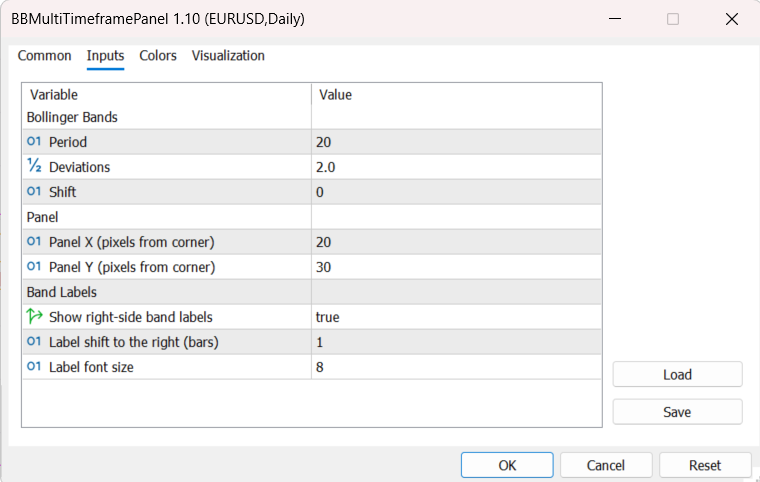
Screenshot of the MT5 indicator parameters/settings window for the MTF Bollinger Bands indicator.
Recommended Settings by Trading Style
| Trading Style | Period | Deviation | Best Timeframes |
|---|---|---|---|
| Scalping | 10–15 | 2.0 | M1, M5 |
| Day Trading | 20 | 2.0 | M15, H1 |
| Swing Trading | 20–50 | 2.0–2.5 | H4, Daily |
| Position Trading | 50 | 2.5 | Daily, Weekly |
Note on Deviation: For more volatile pairs such as GBP/JPY or XAU/USD, increasing the deviation to 2.5 prevents excessive false signals from normal price noise. For calmer pairs like EUR/CHF, the standard 2.0 works well.
What the Shift parameter does: Shift displaces the bands forward or backward in time. Leave this at 0 for standard use — only advanced traders with specific overlay strategies adjust this.
If you want to go beyond the single built-in indicator and plot Bollinger Bands from multiple timeframes on a single chart, our MTF Bollinger Bands for MT5 indicator does exactly that — displaying up to nine timeframes simultaneously so you never miss higher-timeframe context.
Bollinger Bands Trading Strategies in MT5
Strategy 1: Mean Reversion (Ranging Markets)
The core idea: in a ranging market, price tends to revert toward the moving average after extending too far from it. A band touch alone is not a signal — you need confirmation that the move is exhausted. According to research published by the CFA Institute, mean reversion strategies perform best in low-volatility, range-bound market environments — exactly the conditions where Bollinger Bands contract and price oscillates between the outer bands.
Best conditions: Low to moderate volatility, no major news pending, pair trading sideways on higher timeframe.
Long (Buy) Setup
- Price closes at or below the lower Bollinger Band
- A bullish reversal candle forms — engulfing, hammer, or pin bar
- RSI (14) is below 35, confirming oversold conditions
- Enter on the next candle open after confirmation
- Stop-loss: 5–10 pips below the lowest wick of the setup candle
- Take-profit: Middle band (20 SMA) as first target; upper band as second target if momentum holds
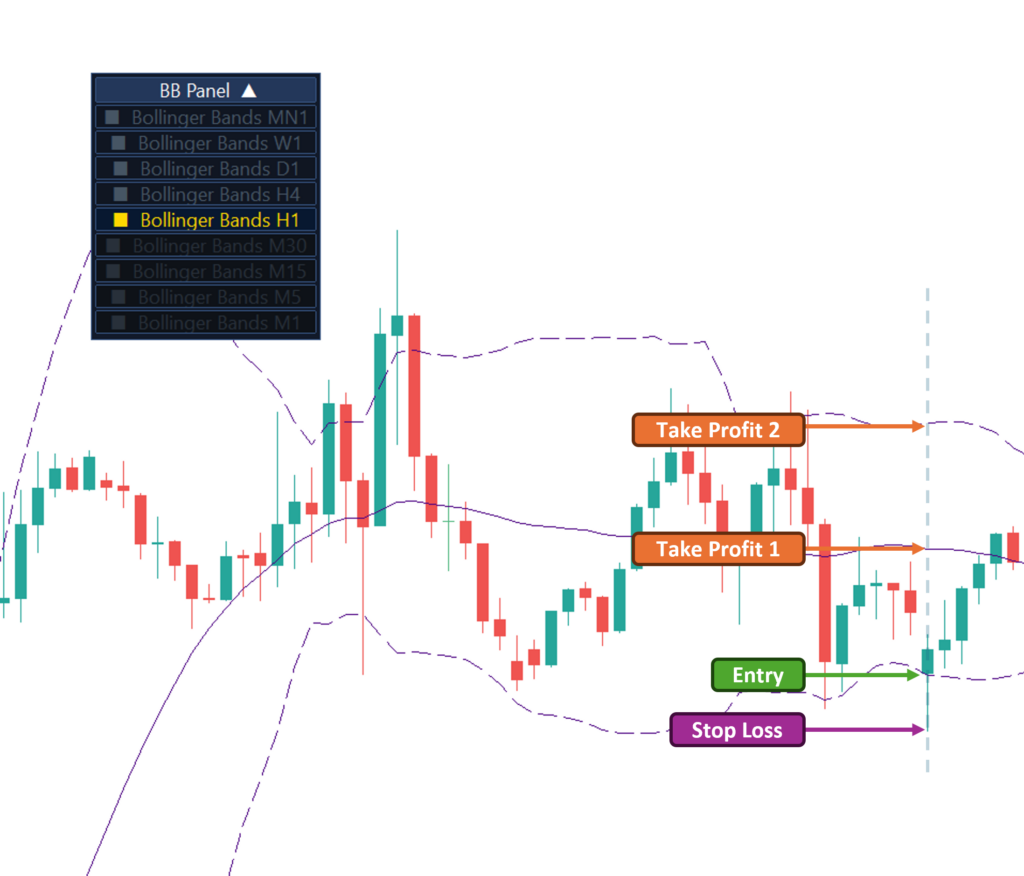
GBP/USD H1 chart with MTF Bollinger Bands. Price touches lower band, hammer candle visible, arrows annotating: Entry, Stop-loss (below wick), TP1 (middle band), TP2 (upper band).
Short (Sell) Setup
- Price closes at or above the upper Bollinger Band
- A bearish reversal candle forms — engulfing, shooting star, or pin bar
- RSI (14) is above 65, confirming overbought conditions
- Enter on the next candle open after confirmation
- Stop-loss: 5–10 pips above the highest wick of the setup candle
- Take-profit: Middle band as first target; lower band as second target
⚠ Critical rule: Do NOT use mean reversion in a trending market. In a strong uptrend, price can walk the upper band for many candles. Always check the higher timeframe before fading a band touch.
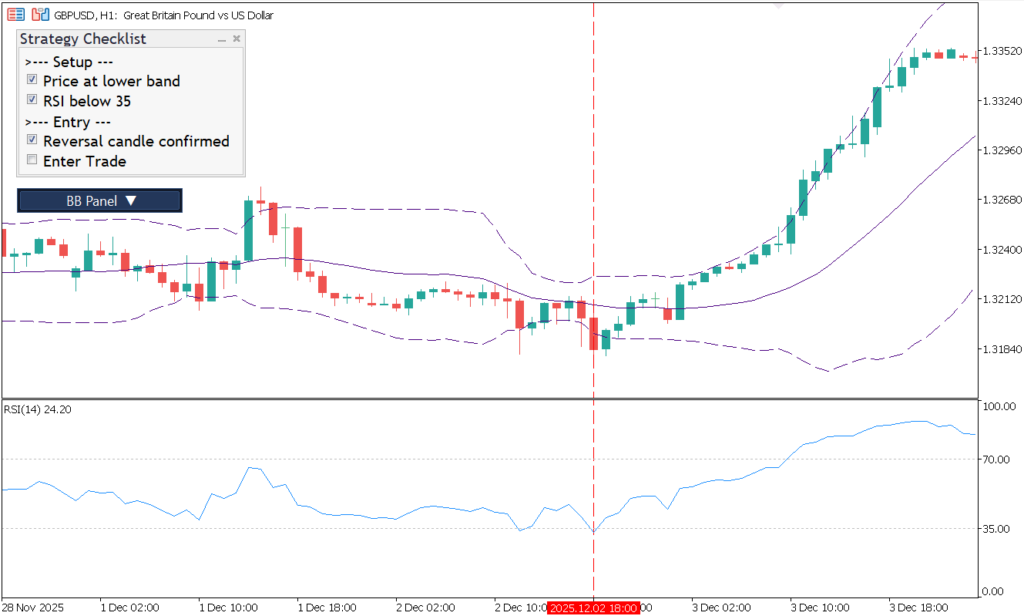
Strategy Checklist MT5 indicator showing Bollinger Bands mean reversion trade checklist on chart
To make sure you never skip your confirmation checklist in the heat of a trade, our free Strategy Checklist indicator lets you define a custom checklist that appears directly on your MT5 chart — helping you enforce discipline on every entry.
Strategy 2: Bollinger Bands Squeeze Breakout
When the bands contract to unusually narrow levels, the market is coiling energy. This is called the Bollinger Squeeze. A breakout from this compression is often the beginning of a significant directional move. The squeeze is one of the most studied patterns in technical analysis — the original squeeze methodology is documented in detail on John Bollinger’s official site.
Best conditions: Following a prolonged period of low volatility (watch bandwidth narrowing over 10–20 candles). Most powerful on H1 and H4 timeframes.
Setup Rules
- Identify a squeeze: bands are the narrowest they’ve been in 20+ candles on your timeframe
- Wait for a strong breakout candle that closes clearly outside a band (not just wicks through)
- Use volume to confirm: a spike in volume on the breakout candle significantly improves reliability
- Enter on the close of the breakout candle, or on a retest of the broken band
- Stop-loss: Place below/above the middle band, or below the low of the breakout candle
- Take-profit: Project the width of the bands at the time of the squeeze — that width is a minimum target
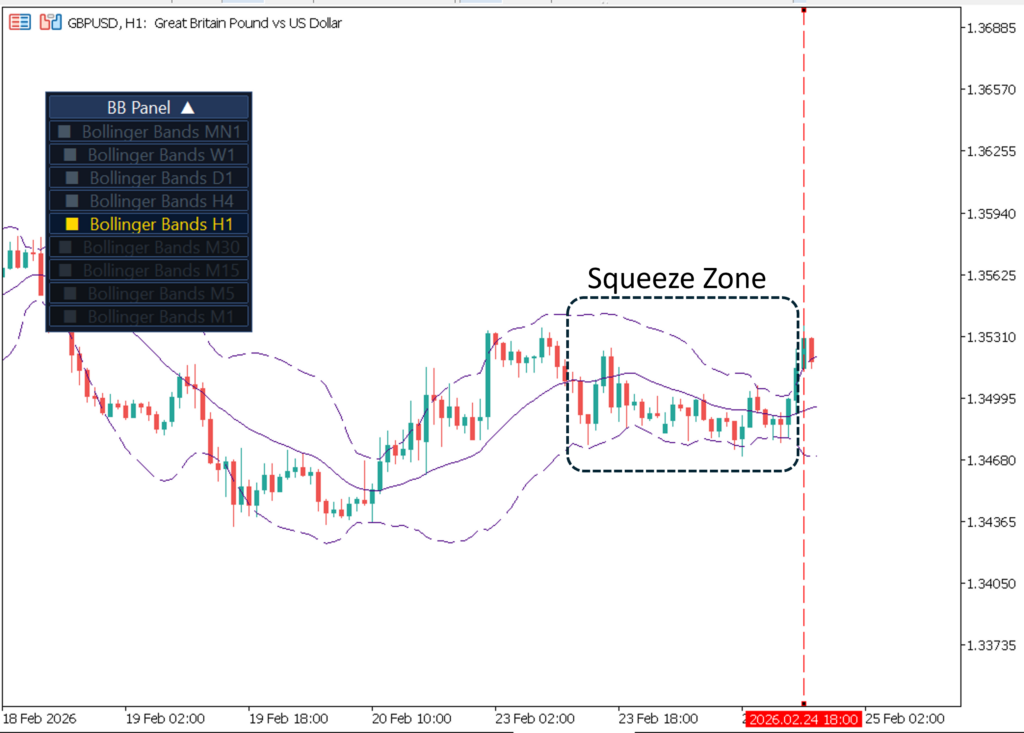
Bollinger Bands squeeze breakout setup on GBP/USD H1 chart in MetaTrader 5
⚠ False breakout filter: If the breakout candle closes back inside the bands on the same session, treat it as a false break and stand aside. Wait for a new squeeze to develop.
For breakout trades triggered by trendline breaks alongside a Bollinger squeeze, our Trendline EA can automate entry and management once a trendline is breached — removing the emotional hesitation that often causes traders to miss the initial breakout candle.
Strategy 3: Trend Trading — Riding the Band
In a strong trend, price doesn’t reverse from the bands — it rides them. This is one of the most consistently profitable Bollinger Band applications and the one most retail traders miss because they’re always trying to fade moves.
Best conditions: Clear higher-timeframe trend, price consistently closing above/below the middle band.
Long Trend Setup
- Higher timeframe (e.g. H4 or Daily) is in a clear uptrend
- Price is above the middle band on your entry timeframe
- Pullbacks to the middle band (20 SMA) are buying opportunities — not reversal signals
- Enter on a bullish candle that bounces from the middle band with volume confirmation
- Stop-loss: Below the middle band (a close below the 20 SMA signals trend weakening)
- Take-profit: Trail stop using the middle band; exit when price closes below it
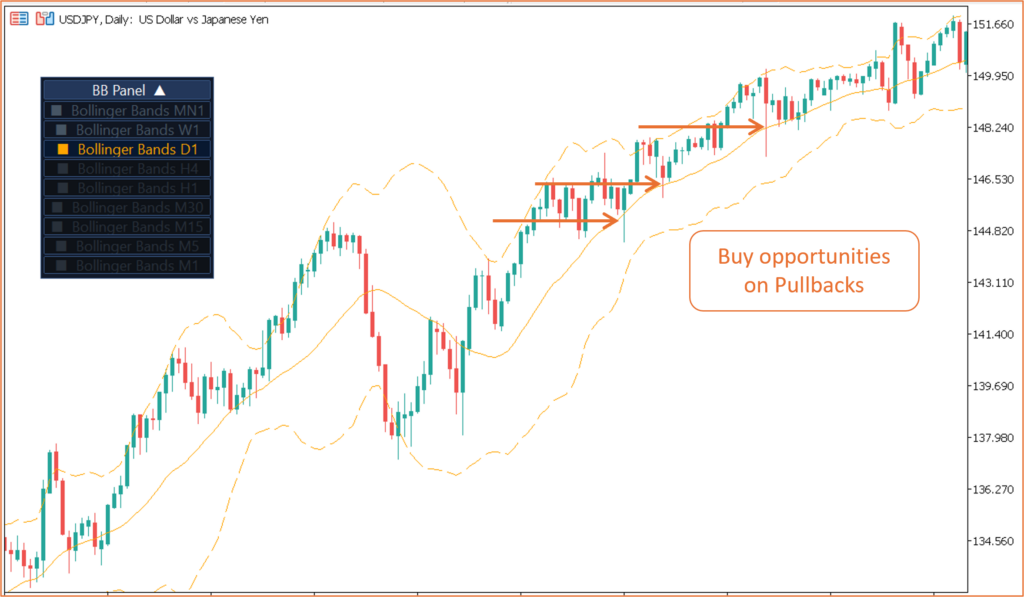
Price riding the upper Bollinger Band during a strong uptrend on JPY/USD D1 chart in MT5 with pullback entries annotated
The same logic applies in reverse for short trend setups. The key shift in thinking: in a trend, the middle band is support/resistance — not the outer bands.
To confirm the higher-timeframe trend direction quickly, our free MTF Triple Moving Averages indicator overlays moving averages from multiple timeframes onto a single chart, giving you an immediate read on whether the trend is aligned across timeframes before you enter.
Adding Confluence: Combining Bollinger Bands with Other Tools
Bollinger Bands are most powerful when combined with other indicators. Here are the highest-value pairings:
Bollinger Bands + RSI
RSI (14) adds a momentum reading to confirm what the bands are showing. The most powerful combination: price touches the lower band while RSI shows divergence (price makes a lower low, RSI makes a higher low). This confluence dramatically increases the probability of a successful mean reversion trade. The RSI indicator was developed by J. Welles Wilder and documented in his 1978 book New Concepts in Technical Trading Systems — its methodology is well explained by Investopedia’s RSI guide.
Bollinger Bands + Volume
Volume is particularly important for breakout trading. A squeeze breakout with 2x average volume behind it is far more reliable than one occurring on thin volume. In MT5, add the Volume indicator (Insert → Indicators → Volumes → Volumes) and look for the volume spike to align with your breakout candle.
Bollinger Bands + Key Levels
When the lower or upper band aligns with a major support/resistance level, previous high/low, or a round number, the probability of a reaction at that level increases significantly. Always mark out key horizontal levels before relying on a band touch alone. Our free FXTT Pivot Points indicator automatically plots key price-based reference levels on your MT5 chart — making it easy to spot when a Bollinger Band touch coincides with a major pivot level.
Bollinger Bands + Multi-Instrument Scanning
Rather than waiting for setups to appear on a single chart, you can scan multiple pairs simultaneously for Bollinger Band conditions. Our free Multi-purpose Forex Scanner monitors multiple instruments at once, saving you the time of flipping through charts manually to find the best setups.
Why Multi-Timeframe Bollinger Bands Give You an Edge
The standard MT5 Bollinger Bands indicator only shows one timeframe at a time. This creates a blind spot: a band touch on the H1 chart might be completely insignificant when zooming out to the H4, where price is in the middle of the bands with plenty of room to run.
Multi-timeframe analysis solves this. When the H4 and H1 both show price at the lower band simultaneously, the confluence of two timeframes pointing to the same zone is a much stronger signal than a single timeframe reading alone. This principle is widely endorsed by institutional technical analysts — TradingView’s community research consistently shows multi-timeframe confluence as one of the top filters for improving signal quality.
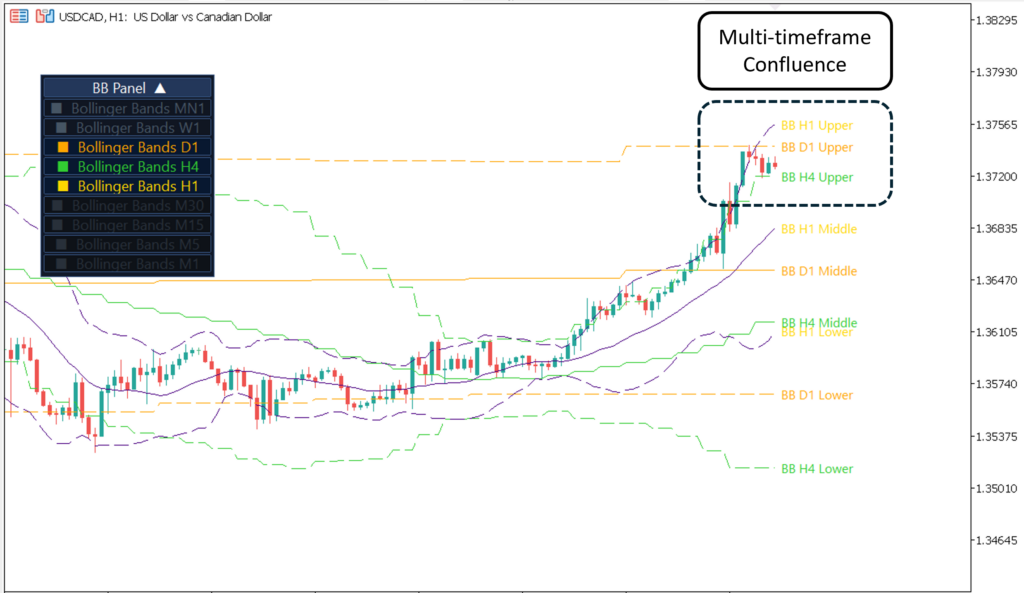
MTF Bollinger Bands MT5 indicator showing H1 H4 and Daily bands simultaneously on USD/CAD chart highlighting multi-timeframe confluence
The MTF Bollinger Bands MT5 indicator overlays bands from up to nine timeframes directly onto a single chart. Instead of guessing whether a band touch is significant, you can see at a glance whether higher timeframes confirm the signal — giving you the context that separates high-probability trades from marginal ones.
If you prefer a free starting point, the MTF Bollinger Bands Free indicator provides the same multi-timeframe overlay concept with core functionality at no cost.
Monitoring Your Performance
Applying any strategy consistently is only half the battle — you also need to track whether it’s working. Equity drawdowns, win rates, and risk-adjusted returns all tell you whether your Bollinger Band approach is actually profitable over time, not just in isolated trades.
The Equity Tracker MT5 monitors your account equity and balance in real time and sends alerts directly to Telegram or Discord when drawdown thresholds are breached — helping you spot when a strategy is underperforming before losses become significant.
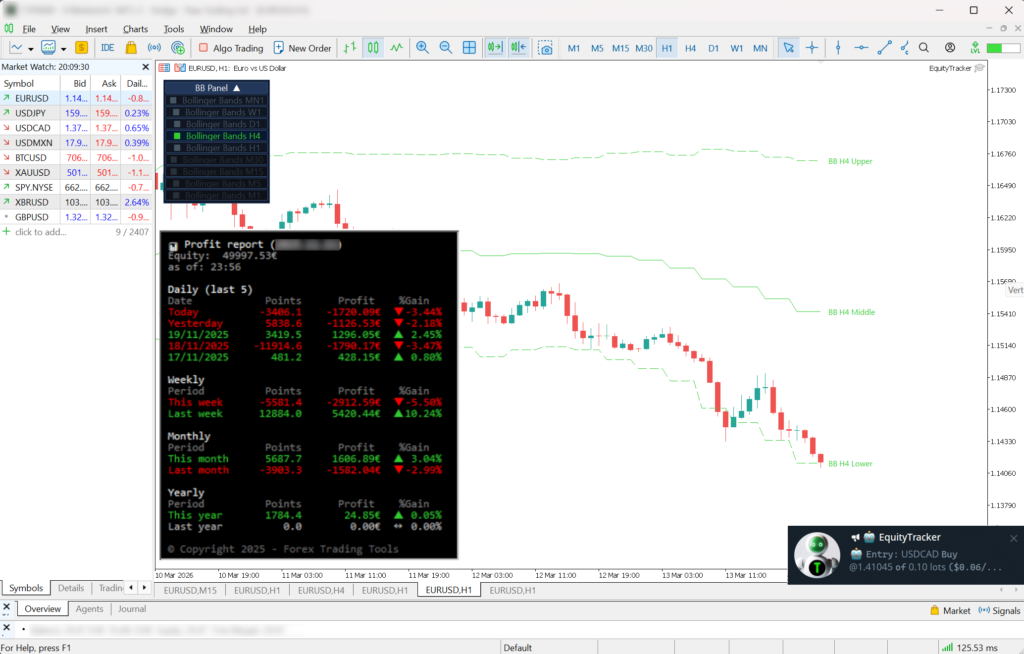
Equity Tracker MT5 showing real-time equity monitoring panel and Telegram entry alert notification
When NOT to Use Bollinger Bands
Knowing when to stand aside is just as important as knowing when to trade. Bollinger Bands perform poorly in the following conditions:
- During major news events: Spreads widen and price can spike erratically through bands without any technical meaning. Avoid setups in the 30 minutes before and after high-impact news (NFP, FOMC, CPI). Use the Forex Factory economic calendar to keep track of upcoming releases.
- In extremely low-liquidity markets: Asian session on GBP or CAD pairs, or trading any instrument near market open/close, produces false signals as thin volume allows price to push through bands without genuine momentum.
- When bands are flat and very wide simultaneously: This pattern suggests a market that has just completed a large move and is in an uncertain consolidation. No clear edge exists for either mean reversion or breakout strategies.
- As a standalone system: No single indicator should be your entire strategy. Always require at least one additional form of confluence before entering a trade based on Bollinger Bands.
Common Mistakes When Trading Bollinger Bands
1. Treating Every Band Touch as a Reversal Signal
This is the most common and costly mistake. In a trending market, price can touch or walk along the outer band for 10, 20, or more candles. A band touch is only a potential reversal signal in a clearly ranging market with confirmation from a reversal candle and a momentum indicator like RSI. Without these filters, you’ll be repeatedly stopped out fighting a strong trend.
2. Ignoring the Higher Timeframe Context
A perfect-looking setup on the M15 is meaningless if the H4 chart is in a strong downtrend. Always establish the higher timeframe bias before entering any trade. Signals that align with the higher timeframe direction have statistically better outcomes.
3. No Stop-Loss Plan
Entering a trade because “price is at the lower band” without a defined stop-loss level is not trading — it’s guessing. Every Bollinger Bands trade must have a pre-defined invalidation point. The Bank for International Settlements has documented that retail traders who do not use pre-defined stop-losses account for a disproportionate share of large account losses. If the setup fails, your loss should be small and defined before you enter.
4. Only Using One Timeframe
Single-timeframe traders miss the full picture. A band squeeze on the H1 that is also visible on the H4 is a significantly stronger signal than one appearing on H1 alone. Build multi-timeframe context into every analysis.
5. Chasing Breakouts After the Move Has Already Occurred
Entering a breakout trade three or four candles after the initial break means you’ve already missed most of the move and are now entering at the point of maximum risk. Wait for either the initial breakout candle close, or a retest of the breakout level, for a better entry.
Frequently Asked Questions
Do Bollinger Bands work for forex trading?
Yes — Bollinger Bands were originally designed with financial markets in mind and work well on forex pairs, particularly on H1 and above timeframes where price action is less noisy. They are most effective on major pairs like EUR/USD, GBP/USD, and USD/JPY.
What is the best timeframe for Bollinger Bands?
For day traders, H1 provides the best balance of signal quality and frequency. Swing traders typically use H4 or Daily. Scalpers can use M5 or M15, but should expect more false signals and require tighter confirmation criteria.
Can Bollinger Bands predict breakouts?
They can identify conditions that commonly precede breakouts — specifically the Bollinger Squeeze pattern — but they cannot predict the direction of the breakout. You must wait for the breakout candle to confirm direction before entering.
What is the best indicator to combine with Bollinger Bands?
RSI (14) is the most widely used complement to Bollinger Bands. Volume indicators help confirm breakout validity. For trend context, a higher-timeframe moving average or ADX (Average Directional Index) adds valuable information. Our MTF Triple Moving Averages indicator is a free option for adding multi-timeframe moving average context directly in MT5.
Should I change the default 20-period setting?
The 20-period default works well for most traders on most timeframes. The main reason to change it is trading style: scalpers benefit from a shorter period (10–15) for faster response; position traders may prefer 50 for smoother signals. Avoid over-optimizing — pick a setting and stick to it consistently.
Final Thoughts
Bollinger Bands remain one of the most powerful and versatile tools available to MT5 traders. They work across instruments and timeframes, combine well with other indicators, and give you a clear, visual read on market volatility at all times.
The key to using them profitably is discipline: apply confirmation filters before every entry, always define your stop-loss before entering a trade, respect the higher timeframe trend, and stand aside during news events and low-liquidity conditions.
When combined with multi-timeframe analysis — particularly using tools like the MTF Bollinger Bands MT5 indicator — Bollinger Bands provide a significant edge. Seeing how multiple timeframes align at the same volatility level is what separates traders who consistently profit from this indicator from those who keep getting caught fading strong trends.