

What Are Pivot Points?
Pivot points are price levels calculated from the previous session's high, low, and closing price. They act as objective reference points on your chart — areas where the market has historically shown a tendency to react, reverse, or break through. According to Investopedia, this method is among the most widely used by day traders and floor traders alike, precisely because it creates a shared, objective framework for reading price.The standard formula is simple:Pivot Point (PP) = (High + Low + Close) / 3From this central pivot, a set of support and resistance levels — S1, S2, S3 and R1, R2, R3 — are derived automatically, giving you a full map of likely price reaction zones for the session ahead.What makes these levels especially powerful is that they're widely used by institutional traders, market makers, and professional desks. That widespread adoption means large volumes tend to cluster around these zones, often making them self-fulfilling.Why Use Pivot Points on MT5?
MetaTrader 5 is one of the most versatile and widely used trading platforms in the world, supporting everything from manual analysis to fully automated strategies via Expert Advisors. However, MT5 doesn't include a native pivot-level tool out of the box — which is exactly where a dedicated pivot points MT5 indicator becomes essential.With the right tool installed, you can:- Instantly visualize daily, weekly, or monthly pivot levels on any chart
- Spot high-probability trade setups at a glance
- Combine these levels with other indicators like RSI or moving averages for confirmation
- Replace guesswork with objective, data-driven price levels
3 Practical Pivot Points MT5 Trading Strategies
1. Bounce Trading at Support & Resistance
The most straightforward approach is to look for price to bounce at a key level. If the market approaches S1 from above and starts showing signs of reversal — a bullish candlestick pattern, RSI divergence, or a volume spike — that's a potential long entry. Conversely, if price rallies toward R1 and stalls, you have a potential short setup.This works well in combination with other support and resistance techniques like trendlines — when a pivot level and a trendline intersect, the signal becomes considerably more reliable.Pro tip: Always wait for confirmation. A single candle touching a level isn't enough. Look for a close, a pattern, or a secondary indicator signal before pulling the trigger.2. Breakout Trading
When price breaks decisively through a pivot level — especially the central PP — it often signals strong directional momentum. Traders enter in the direction of the breakout and target the next pivot level as a take-profit zone.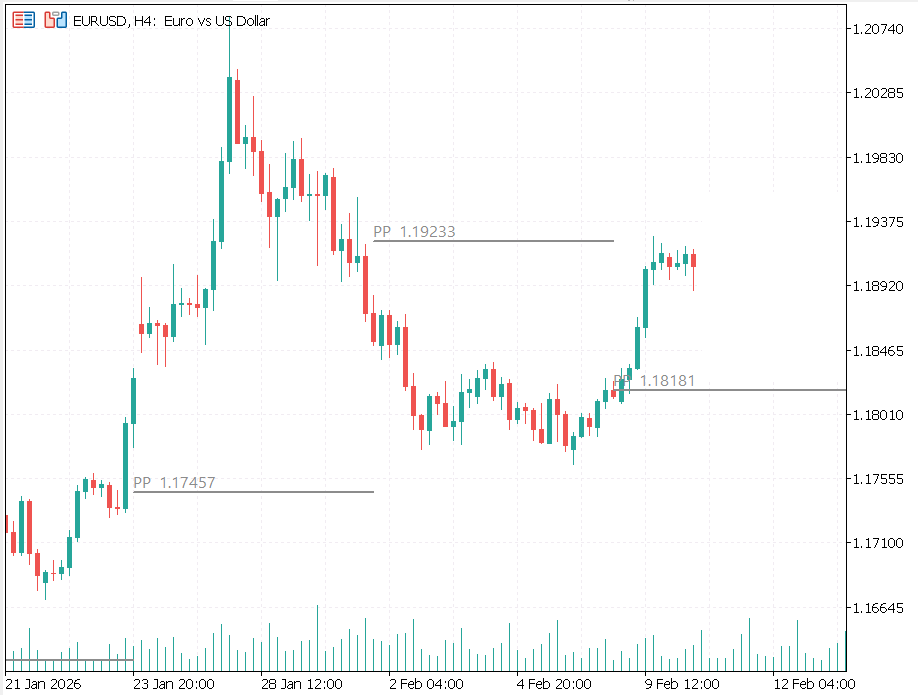
Pivot-Points-Breakout-Example
3. Confluence Trading
This is where these price levels truly shine. When a pivot level aligns with another technical element — a moving average or trendline, a Fibonacci retracement, a previous swing high or low — the combined signal carries significantly more weight.For example, using our free MTF Triple Moving Averages indicator alongside pivot levels is a powerful combination: when price tests a pivot while all three MAs are aligned in the same direction, the probability of a meaningful reaction increases sharply.Pro tip: The more confluence, the higher the probability. Two or three factors pointing to the same level is far more reliable than any single indicator on its own.Building a Rule-Based System Around Pivot Levels
One of the most common mistakes traders make is using these levels reactively — waiting for price to hit a level and then improvising. A better approach is to define your rules before the market opens: which levels matter today, what confirmation do you need, and where your stop and target sit.If you haven't already built a structured framework for your entries, our guide on how to build a rule-based forex strategy in MT5 is a great companion to this article — it walks through the exact process of turning a trading idea into a consistent, repeatable system.Setting Up the FXTT Pivot Points MT5 Indicator
Getting started is easier than you might think. The FXTT Pivot Points indicator for MT5 plots all major levels directly on your chart — clearly labeled, fully customizable, and completely free to download.Once installed, you'll see the central pivot (PP) along with S1, S2, S3 and R1, R2, R3 automatically calculated and updated each session. From there, simply apply the strategies above and let the levels guide your analysis.
Fxtt Pivot Points Indicator for MT5